The Hands All but Fly: Why We Need Art
The week has been a blur. Some weeks really do seem to go by faster than others, and this one has been like that. A whoosh of days, comings and goings, calls and appointments, clients and collapsing on the couch after dinner to play Candy Crush and watch a show before bed.
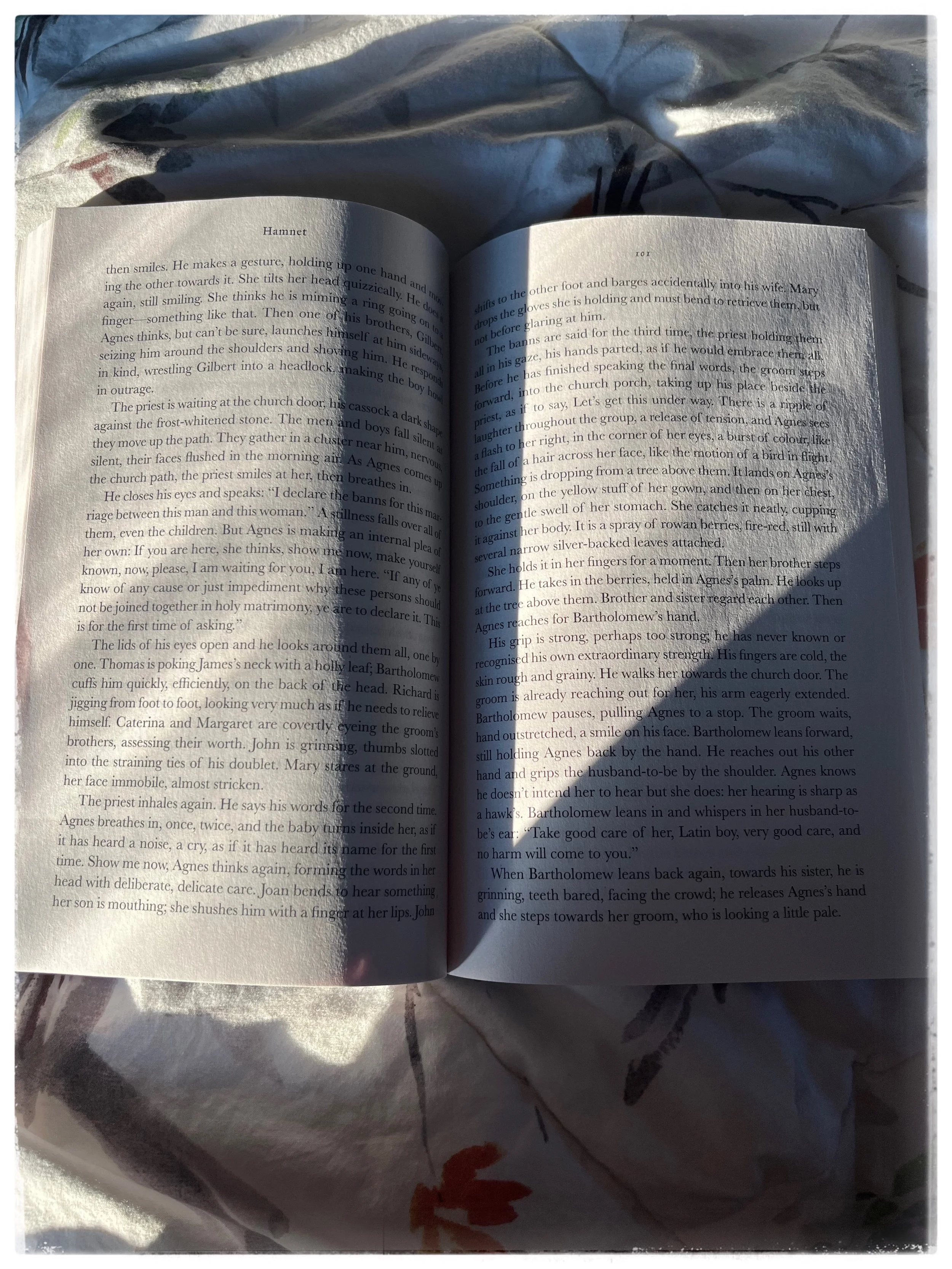
I finished Hamnet. I cried. It is one of the most extraordinary books I’ve read. I’m anticipating seeing the movie, and already have a feeling it may be up there with the few films where I’ve sat in the theater as the credits rolled, tears rolling down my cheeks, pinned to my seat. Ravaged. Somehow seen. Changed. These were, chronologically, The Piano, Schindler’s List, and Brokeback Mountain. (If you know me, this will probably make sense.) Each of these left me unable to carry on with the normal kind of chit-chat one might share with fellow movie-goers on the way back to the car or the subway or to grab a bite to eat.
This week, I started a new morning ritual with my coffee. It’s a mash-up of morning prayers and morning pages. First, I recite Modah ani while I’m still in bed, often singing the words to the tune of this Elana Jagoda version of the prayer, which we listened to when the kids were little.
The week has been a blur. Some weeks really do seem to go by faster than others, and this one has been like that. A whoosh of days, comings and goings, calls and appointments, clients and collapsing on the couch after dinner to play Candy Crush and watch a show before bed.
I finished Hamnet. I cried. It is one of the most extraordinary books I’ve read. I’m anticipating seeing the movie, and already have a feeling it may be up there with the few films where I’ve sat in the theater as the credits rolled, tears rolling down my cheeks, pinned to my seat. Ravaged. Somehow seen. Changed. These were, chronologically, The Piano, Schindler’s List, and Brokeback Mountain. (If you know me, this will probably make sense.) Each of these left me unable to carry on with the normal kind of chit-chat one might share with fellow movie-goers on the way back to the car or the subway or to grab a bite to eat.
This week, I started a new morning ritual with my coffee. It’s a mash-up of morning prayers and morning pages. First, I recite Modah ani while I’m still in bed, often singing the words to the tune of this Elana Jagoda version of the prayer, which we listened to when the kids were little.
I reflect on something I learned recently, which is that the Hebrew verb, modeh/modah, means not only “thanks” or “thank you,” but also “admit” and “surrender.” So, we begin the day with gratitude as well as honesty and humility.
Thank you for the gift of a brand new day. I admit I missed the mark yesterday in some ways and will undoubtedly do so again today. I surrender to the beautiful largesse of this life, much of which is out of my control, and also commit to bringing intention to the parts that are within my control.
All of this, in a single word!
After I’m downstairs, after I’ve fed Chalupa and taken her outside, I sit down with my coffee and write a short morning letter to God. (I’m still working out whether to drop the “o.” I asked God; they don’t seem to have a strong preference.)
I have no “rules” for the letter. It’s just a greeting, a chance to say hello, hi, I’m here, you’re there, here we are. Often, these letters end up filling up with things I’m thankful for, as it really is such a grounding way to start the day. They are also repositories for whatever else is knocking around in my head and heart – reflections, dreams, ideas, concerns, requests.
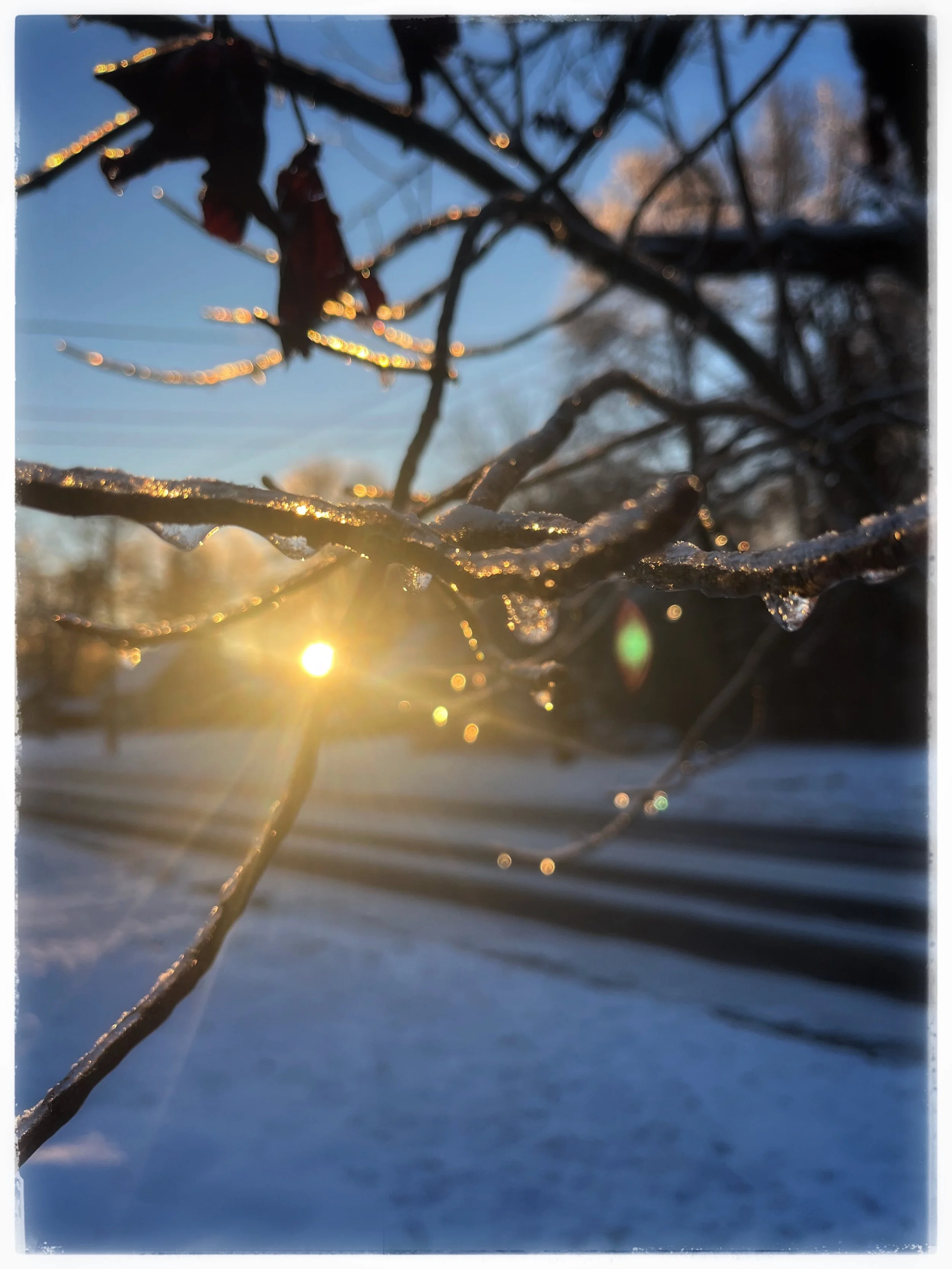
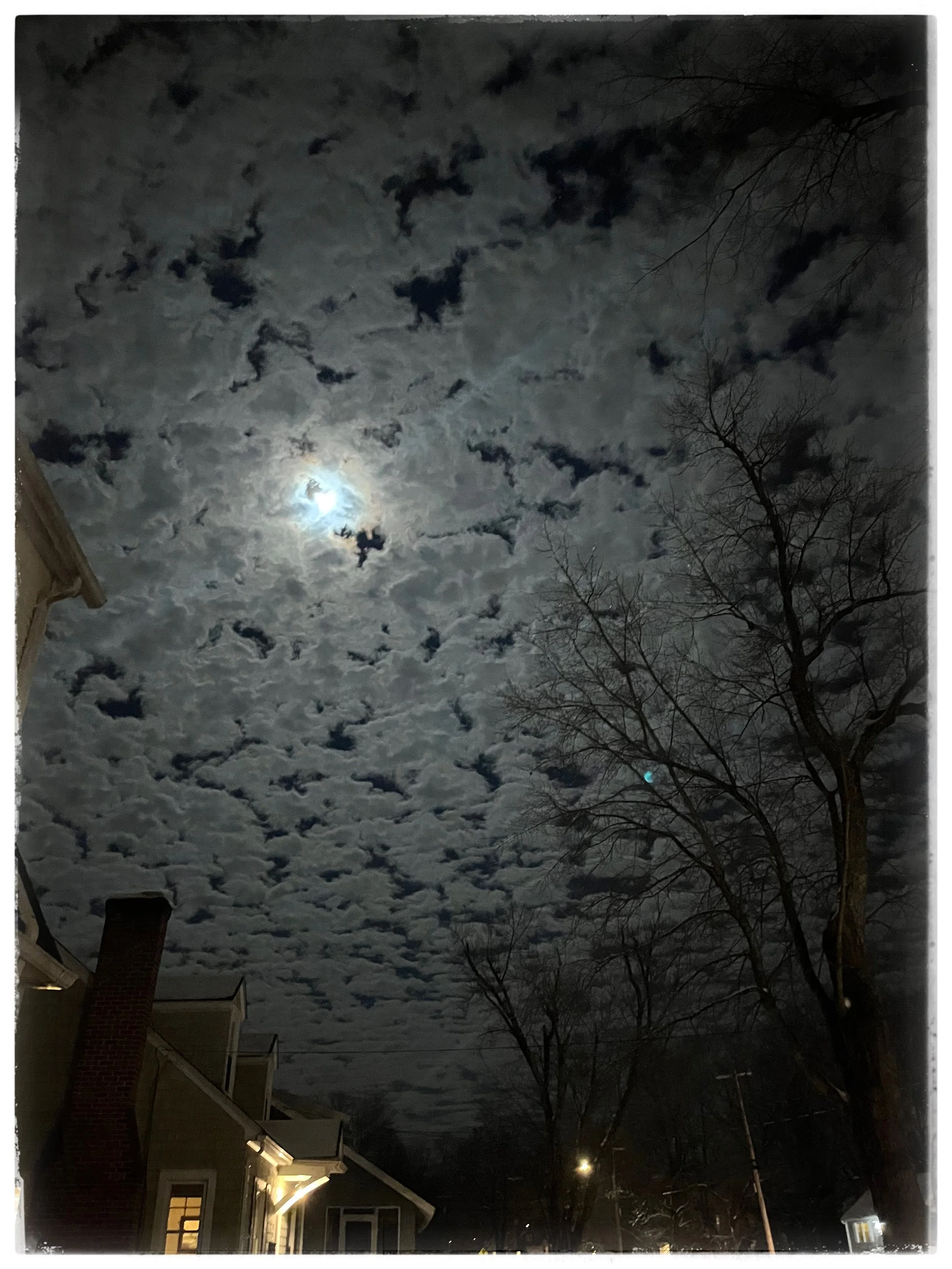
Tuesday brought the first real snow of the year, which by mid-afternoon had turned into sleet. On Wednesday morning, the treetops sparkled with sunlit ice. Wednesday night, the nearly full moon rested on a smashed mosaic of clouds. To begin the day with a star and end the day with a moon, what could be simpler, what more effortless?
And yet it is all so easy to miss, in the rush and whir of obligations and commitments, conversations and moods and to-do lists and bodies with their aches and pains and creaks and quirks.
It’s not that time isn’t passing all the same; it is, has, does, and will. It’s that without intentional daily creative and spiritual practices, the hands all but fly off the clock.
I spent a good amount of time with my dad in the last week at various medical appointments. Yesterday, we drove to the Newton-Wellesley MGH for him to get the drains removed (yay!).
As we headed East on the Mass Pike, I mentioned the impending supermoon. I learned from my dad that the moon is moving away from the Earth at a rate of about 1.5” per year. Who knew? From there, we ended up talking about time and space – two of my dad’s favorite topics and, not surprisingly, two of mine.
To wit: The Earth is approximately 4.6 billion years old and has approximately 5 billion more years before the sun dies, at which point the Earth will probably long have been uninhabitable. People, who have been on the planet for between 200,000 and 300,000 years, are doing a stellar job (no pun intended) of speeding up this part of the process.
Hold up.
BILLION.
There is a lot of talk about billionaires these days, seeing as they bear much of the responsibility for said speeding up of planetary destruction. And while this is a very important topic, I am stuck on the numbers. BILLIONS. I don’t care if we’re talking dollars or years – what even IS that?! How are we to comprehend something of that scale, when it downright dwarfs everything relatable?
I remarked to my dad that it’s always so incredible to sit with that perspective and juxtapose it with our lives, our time here, not even a blip as a species, much less our individual lives. And yet, and yet. Our lives are so important. Why and how is that? Why does it matter so much when it is such a blip?
“Because we have an obligation to each other and the planet,” came my dad’s answer.
We have an obligation to each other and the planet.
Somehow, our human experience manages to mirror the vastness and incomprehensibility of time and space despite its minuscule scale and size and span.
This is why poems, songs, movies, books, paintings, dances, and other art forms break us open. We humans contain a miraculous ability: To translate the simultaneous feeling of immensity and teeny-tiny-ness into forms that convey some shared, mind-boggling, heart-wrenching, gut-punching, soul-stirring experience.
It’s why we need art!
It’s why we need to notice and name and cherish the smallest observations and interactions, why we need to crouch down to listen when a child is speaking, lean in closer when we see that someone is agitated and not being understood, hold the door when someone is struggling behind us with too many bags or hands to keep track of, offer help when we can, at the very least, smile, and try, try, try everyday to remember that life is very short, very demanding, and very unpredictable.
Fortunes change on a dime. The sun rises and sets, the moon waxes and wanes. Years become decades become centuries, which is give or take the longest any of us can expect to be here, if that. But even centuries and millennia are but an eyelash on the long face of time. Pfffffft. Make a wish.
Sometimes, I wonder why I write. And then I write and the writing becomes the answer. It’s not that writing always helps me make sense of things. It’s that writing helps me come back to the present moment. It is a mechanism for surveying the disparate and far-flung thoughts and facts and feelings and experiences of any given moment. Writing helps me relax a little more fully into what is as well as what I don’t understand, which is almost everything. It makes me feel less inconsequential on the one hand, and more inconsequential on the other – and both of these can come as a relief.
Everything matters so much, and none of it matters at all. And somewhere, dear reader, between that deep faith and total nihilism, there is a field. Come meet me there. Let’s clink glasses to the mystery.